

The Shadow Integration Framework
A Sequential Model for Trauma Programming and Psychological Integration

A Sequential Model for Trauma Programming and Psychological Integration
Psychological integration is not a single event or a single pathway. Human cognition, emotion, memory, and physiology operate through multiple interacting systems that influence one another continuously. As a result, there is no evidence that one universal sequence exists for integrating every psychological wound.
This framework represents one proposed pathway through that complexity. It organizes established principles from neuroscience, psychology, trauma research, and somatic therapy into a structured sequence that can be observed, practiced, refined, and tested. The sequence itself is a working hypothesis. The biological and psychological mechanisms associated with each state are independently supported within their respective fields.
The purpose of this framework is not to replace existing therapeutic models. It is to provide an organized structure that helps individuals move from unconscious trauma responses toward conscious integration.
The Structure
I have a framework I’ve been working on for a while, and have mentioned parts of it here and there. The working title is Mitosis of God — a 1-9 mitosis of evolution, viewed through the lens of geology, psychology, biology, and physics. It’s still developing, and not something I’m ready to present in full. But it’s where the following sequence comes from.
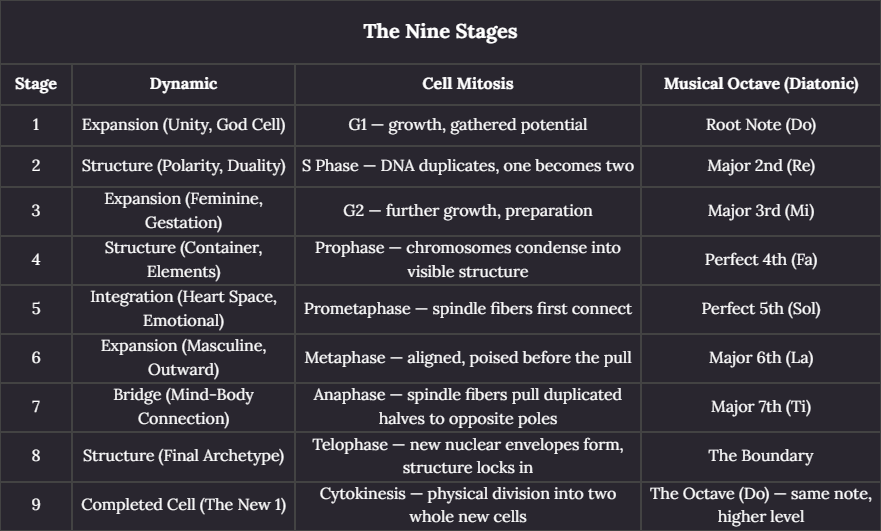
If the nine stages are the vessel, then these two following sequences are the mechanics. This framework uses six structured states of integration:
State 1 → State 2 → State 4 → State 8 → State 7 → State 5
A sequence that mirrors the programming process in reverse:
State 5 → State 7 → State 8 → State 4 → State 2 → State 1
The mirrored relationship reflects a simple observation found throughout neuroscience. Many learning processes require activation before modification. Memory reconsolidation research demonstrates that previously stored emotional learning must first be reactivated before it becomes capable of change. Likewise, trauma programming begins with lived experience and gradually becomes an automatic response, while integration begins with awareness of that automatic response and gradually returns conscious regulation to the nervous system.
The numerical structure serves as an organizational map rather than a biological law. It provides a consistent method for navigating these processes.
Connection to Ankh, Cross & Crux
The Ankh’s structure is a loop resting above a grounded cross. Crosses and crossroads carry this same weight across many traditions: thresholds, turning points, the place before a transformation completes. Even the sky tells this story. The word “solstice” means “sun standing still,” and for about 3 days around the winter solstice, the sun’s path genuinely appears to pause before daylight begins its return. I notice this same shape everywhere I look: the sun’s pause before the light returns, the three days between Jesus’s death and resurrection, and, in Egyptian belief, the Ankh itself, often read as a joining of the unseen and the manifest, translated literally as “life,” appearing throughout Egyptian art and myth as something that restores a static state back into a living one. Most vividly, this shows up in the story of Isis reassembling the scattered body of Osiris and returning breath to him, which is my interpretation of shadow integration: returning your fragmented consciousness back to your whole.
I’m not claiming the ancient Egyptians had any concept resembling modern psychological integration, and I’m not claiming this symbol validates my sequence. I’m only saying: something about a loop returning to wholeness after fragmentation resonates with this sequence for me, because there is an expansion ascend, followed by a heart space, and then a descend back to source.
Why Are 3, 6, and 9 Missing?
This omission is deliberate.
Within my larger Mitosis Framework, these three states belong to a separate layer of psychological organization concerned with consciousness, expansion, and higher-order integration. The present framework focuses only on the structured processes involved in trauma formation and trauma integration.
Rather than introducing unfinished concepts, I have intentionally limited this model to the six states that describe this specific pathway. The broader Mitosis Framework will explain how these two systems relate to one another when it’s ready to be shared.
The Descent: How Trauma Becomes a Program
State 5: Emotional Charge
Every learning process begins with significance.
When an experience carries sufficient emotional intensity, the brain assigns priority to it through the interaction of the amygdala, hippocampus, and salience network. Strong emotional experiences are more likely to become durable memories because the nervous system interprets them as important for future survival.
This initial emotional charge provides the energy that begins the programming process.
State 7: Somatic Encoding
Before experience becomes language, it becomes physiology.
Changes in breathing, muscle tension, heart rate, posture, facial expression, and autonomic regulation occur within milliseconds through neuroception and autonomic nervous system activity.
Many aspects of traumatic experience become encoded as implicit bodily memory before conscious narrative develops.
State 8: Narrative Construction
The brain naturally constructs explanations for physiological experience.
Networks involved in autobiographical memory and self-referential thinking, particularly the Default Mode Network, organize sensations into coherent personal narratives.
These narratives often become implicit beliefs such as:
“I am unsafe.”
“I cannot trust people.”
“I always fail.”
The story is not the trauma itself. It is the brain’s interpretation of physiological experience.
State 4: Emotional Organization
As narratives stabilize, emotional patterns become increasingly predictable.
Research on emotional granularity demonstrates that emotions become more identifiable and repeatable over time. Similar situations begin producing similar emotional responses.
The nervous system develops increasingly efficient emotional predictions based on previous learning.
State 2: Defensive Organization
Repeated emotional responses gradually organize into broader defensive strategies.
Polyvagal Theory and autonomic neuroscience describe predictable patterns of mobilization and immobilization. Examples include:
outward projection, confrontation, control, hypervigilance
inward withdrawal, collapse, appeasement, dissociation
These patterns become habitual ways of responding to perceived threat.
State 1: Program Formation
Eventually the entire sequence becomes automatic.
Future experiences no longer require conscious evaluation. The nervous system recognizes familiar cues and activates previously learned physiological, emotional, and cognitive responses almost immediately.
The original adaptive response has become an implicit program.
The Ascent: How Integration Reorganizes the Program
Integration follows the same pathway in reverse because implicit learning must first become conscious before it can be modified.
State 1: Recognition
Integration begins by recognizing that a program is active.
This recruits prefrontal cortical networks responsible for observation and cognitive regulation, creating distance between awareness and automatic reaction.
State 2: Nervous System Identification
The next task is identifying the body’s current defensive organization. Examples include:
mobilization
immobilization
projection
withdrawal
Research on affect labeling demonstrates that naming internal states reduces amygdala activity while increasing prefrontal regulation. The objective is not analysis but recognition.
State 4: Emotional Differentiation
Once physiological activation decreases, emotional awareness becomes more precise.
The insular cortex integrates bodily sensations with conscious emotional awareness, allowing vague distress to become specific emotional experience. Emotional specificity improves emotional regulation and reduces generalized distress.
State 8: Narrative Examination
With emotional stability restored, the underlying narrative can be examined.
The Default Mode Network continuously constructs personal identity from past experience. Integration involves observing these narratives without automatically accepting them as objective reality. Questions such as these become possible:
“What belief am I operating from?”
“Is this belief still accurate?”
“What experience originally taught me this?”
This process separates autobiographical narrative from present reality.
State 7: Somatic Integration
Psychological insight alone rarely completes integration.
The nervous system often continues carrying physiological activation after conscious understanding develops. Interoceptive awareness, breathing, movement, tremoring, grounding, and other somatic interventions help complete incomplete defensive responses while restoring autonomic regulation.
The objective is physiological completion rather than cognitive suppression.
State 5: Compassionate Integration
The final stage introduces safety while the original learning remains active.
Research on self-compassion, autonomic regulation, and memory reconsolidation suggests that previously stored emotional learning becomes modifiable when reactivated under conditions that contradict its original expectation. Compassion, acceptance, and physiological regulation provide this corrective experience.
Rather than erasing memory, the nervous system updates the meaning attached to it. The event remains. The automatic survival program becomes less necessary.
Closing Perspective
Everything in this piece comes back to the same honest starting point: this is a working hypothesis, not a finished discovery.
The neuroscience supporting affect labeling, autonomic regulation, interoception, emotional granularity, narrative identity, self-compassion, and memory reconsolidation exists independently of this framework. The contribution of this model is not the discovery of new biological mechanisms. Its contribution is proposing a coherent sequence that organizes those mechanisms into one possible pathway for trauma programming and psychological integration.
Like any developing framework, its value depends on observation, refinement, replication, and continued testing.
This framework is still evolving, and its real value will come from how it holds up in practice, not just in theory. If you work through this sequence, I’d genuinely love to hear how it landed for you. I’ve put together a short, anonymous reflection guide as a way to walk through the six states, with space to note what resonated, what didn’t, and anything you noticed along the way. Your responses help this framework sharpen into something that actually works for real nervous systems, not just on paper or through my personal experience. You can find it [here].